
Walt Disney Studios Park: 24 Years of Magic, Secrets, and Disappeared Attractions
게시일 2026. 3. 29. - 업데이트일 2026. 4. 28. - 작성자: Magic Tips

A park born too small, too quickly, and yet become one of the most beloved places in Europe. The complete story of Walt Disney Studios Park, from Terrorific Nights to Electroland, from CinéMagique to Moteurs… Action!, from the Tower of Terror to Ratatouille.
It was on March 16, 2002, on a spring morning in the Paris region, that a second park finally opened its doors in Marne-la-Vallée. Walt Disney Studios Park arrived ten years after its big brother, skinny, criticized, insufficient — Roy E. Disney himself would say it wasn't big enough to fit a mouse's foot in. And yet, this park would hang on. It would grow, reinvent itself, mourn its lost attractions and give birth to new ones. It would harbor secrets no one asked to be slipped into the sets, host electro festivals and anthological horror nights, win awards no one expected, and become home to some of the most beloved shows in Europe. Here is the full tribute this park deserves.
Born in a Hurry (1987–2002)

The agreement signed on March 24, 1987, between the Walt Disney Company and the French public authorities contained a discreet but decisive clause: if no second park was built before 2002, the French State would recover part of the land allocated to Disney. Therefore, it was not merely a creative ambition that gave birth to Walt Disney Studios Park — it was also an absolute contractual obligation.
The original project bore a much more glamorous name: Disney-MGM Studios Europe, an almost exact replica of the Floridian studios, with real active film sets, tourable animation studios, and a planned opening in 1995. The financial crisis of Euro Disney in 1992 swept everything away: project frozen, plans shelved, ambitions drastically downsized. It would take until 1999 for the Imagineers to get back to work, with a tight budget and only 30 months to deliver an entire park.
610 million euros would ultimately be invested in it. A colossal budget in absolute terms, but insufficient for the initial titanic vision. Rémy Julienne, the famous French stuntman (James Bond, La Grande Vadrouille), was one of the very first European consultants called to the rescue. He would design the jewel of the park: Moteurs… Action! Stunt Show Spectacular, involving his own sons and nephew.
On March 16, 2002, Walt Disney Studios Park opened its doors under a clear sky. Michael Eisner, then CEO, delivered his inaugural speech in front of cameras from all over the world. The spotlights turned on. But analysts grimaced: only 13 activities, 25 hectares — half the size of its neighbor. The challenge had only just begun.

The Origins: What the Park Was When It Opened

In 2002, the park was divided into four distinct zones, meant to simulate a thriving production studio: the Front Lot (the majestic entrance, the Place des Frères Lumière, and Studio 1), the Animation Courtyard (dedicated to the art of drawing), the Production Courtyard (television sets and backstage), and the Backlot (the industrial zone for special effects, adrenaline, and stunts).
Studio 1, this immense covered entrance hangar, is an unrecognized scenographic feat. Its walls are painted according to a precise gradient: light blue at the top, warm orange towards the ground, simulating a permanent Hollywood dusk. Whatever the time, the season, or the storm raging outside, inside Studio 1, the sun always sets gently over Hollywood Boulevard.
In the first year, 2.8 million visitors discovered the park due to its novelty. The year 2003, the first full year of operation, dashed hopes with only 2.2 million admissions — half of what was expected. Attendance would stagnate around this figure until 2007, penalized by the aftermath of September 11 on global tourism and a glaring lack of family attractions.
On a scenographic level, however, the park had some undeniable assets from the moment it opened. The Place des Stars, in the Production Courtyard, received the hand and footprints of artists like Julie Delpy, Rémy Julienne, Roger Moore, and Angela Lansbury, cast in concrete in the image of the famous Grauman's Chinese Theatre in Hollywood.

CinéMagique (2002–2017): The Lost Masterpiece

If only one legend were to remain to define the 2002–2017 period of the park, it would undoubtedly be CinéMagique. Installed in the imposing Studio Theater, this attraction transcended the concept of a theme park to offer a true love letter to the seventh art, with a poetry and intelligence that have become rare.
The concept: an annoying visitor (Georges, played on screen by Martin Short) answers his phone in the middle of a dark theater. By magic, he is sucked into the screen, navigating from one classic film to another, disrupting Titanic, Star Wars, The Good, the Bad and the Ugly, or Mary Poppins. He desperately tries to return to the real world, while falling under the spell of Marguerite (Julie Delpy), a heroine traveling through the history of silent to modern cinema. A third actor played the Magician: Alan Cumming, a mischievous accomplice who triggers and tries to resolve the spell.
The millimeter-perfect synchronization between the physical actor — who was actually running on the stage — and his digital avatar, who instantly appeared on the screen, left the audience speechless. The illusion was perfect, especially during the scenes of Titanic or The Little Mermaid where the transitions between real and filmed were totally imperceptible. Awarded a Thea Award in 2003 (the Oscar of theme parks), the attraction played more than 46,000 performances in fifteen years.
In May 2012, the film was updated: several aging sequences were replaced by excerpts from more recent Pixar productions, including Ratatouille and The Incredibles, rejuvenating the show without betraying its spirit.
On March 29, 2017, the final screening was held to a sold-out crowd, in a theater filled with tearful fans. Collector tickets stamped with the number 16032002 — the park's opening date — were distributed for the occasion. The Marvel stunt show that took its place never managed to make anyone forget the magic of Georges and Marguerite.

Animagique (2002–2016): The Magic of Black Light

While CinéMagique catered to cinema lovers, Animagique was the beating heart of the Animation Courtyard for families. Based on the ancient but highly mastered technique of black light theater, the attraction presented an unforgettable fluorescent ballet.
Animated by dozens of puppeteers dressed entirely in black velvet — making them invisible under ultraviolet spotlights —, huge puppets of Dumbo, Pinocchio, Baloo, Ariel, and Simba floated, danced, and dived above the stage and sometimes the audience itself. The underwater scene from The Little Mermaid, where the entire theater seemed plunged into an ocean of neon colors, was particularly striking. The finale, bringing Mickey together as the Sorcerer's Apprentice in a luminous apotheosis of confetti, invariably provoked spontaneous standing ovations.
The technique, as old as Japanese puppet theater, reached a level of execution here rarely equaled in a Western theme park. Each character required a team of two to four manipulators, coordinated down to the second to a soundtrack built around the greatest musical hits of Disney classics. Before the park opened in 2002, the manipulators had taken Tai Chi classes to perfect their spatial awareness in total darkness.
After 14 years of good and loyal service and 28,700 performances in front of 17 million spectators, Animagique took its final bow on January 31, 2016. Unlike CinéMagique, it gave way to a successor that would prove just as worthy of this theater: Mickey and the Magician.

Moteurs… Action! Stunt Show Spectacular (2002–2020): The Concrete Monster

It was the colossus of the park. With its titanic bleachers capable of accommodating 3,200 spectators per show, the Moteurs… Action! Stunt Show Spectacular was a village all by itself. The set reproduced a Mediterranean port inspired by Villefranche-sur-Mer, with its canal, its ochre-colored market, and its perfectly imitated narrow streets.
The genius idea of the Imagineers was to entrust the design of this pyrotechnic and automotive show to the world's leading authority in the field: the Frenchman Rémy Julienne. A legendary stuntman whose filmography covers more than 1,400 films (James Bond, La Grande Vadrouille, The Mad Adventures of Rabbi Jacob), Julienne designed the show with his own sons and nephew. For 45 minutes, the audience watched the live shooting of an action movie: how a car drives on two wheels, how a driver is replaced by a dummy during an explosion, how a motorcycle jumps through a wall of flames, how to film a car chase in reverse thanks to an entirely inverted chassis.
The attraction was such a triumph of engineering that it was reproduced identically in the United States, at Disney's Hollywood Studios, in 2005. The fleet of vehicles was maintained full-time by a dedicated mechanical team: each car had been custom-built, some concealing gas tanks for fire effects, others equipped with hydraulic controls allowing for spectacular tilting.
The show ended in the most tragic of ways: on the evening of March 13, 2020, the park closed its doors in an emergency due to the global Covid-19 pandemic. The stuntmen put the vehicles away without knowing that the curtain had just fallen for good. After 18 years and approximately 60,000 performances, the show would never reopen.

Studio Tram Tour & Armageddon: The Adrenaline of the Backlot

The Backlot was the antithesis of the fairy tales of Disneyland Park. Here, asphalt replaced the cobblestones of Main Street, industrial hangars succeeded castles, and the atmosphere was resolutely rock and pyrotechnic.
The highlight of the visit was the Studio Tram Tour: Behind the Magic (2002–2020). Guided by the voices of Irène Jacob and Jeremy Irons, the tram traveled through the backstage of the studio before entering Catastrophe Canyon. There, a simulated earthquake triggered the explosion of a tanker truck and a flash flood releasing tens of thousands of liters of water onto the wagons, all under the suffocating heat of ten-meter-high flames.
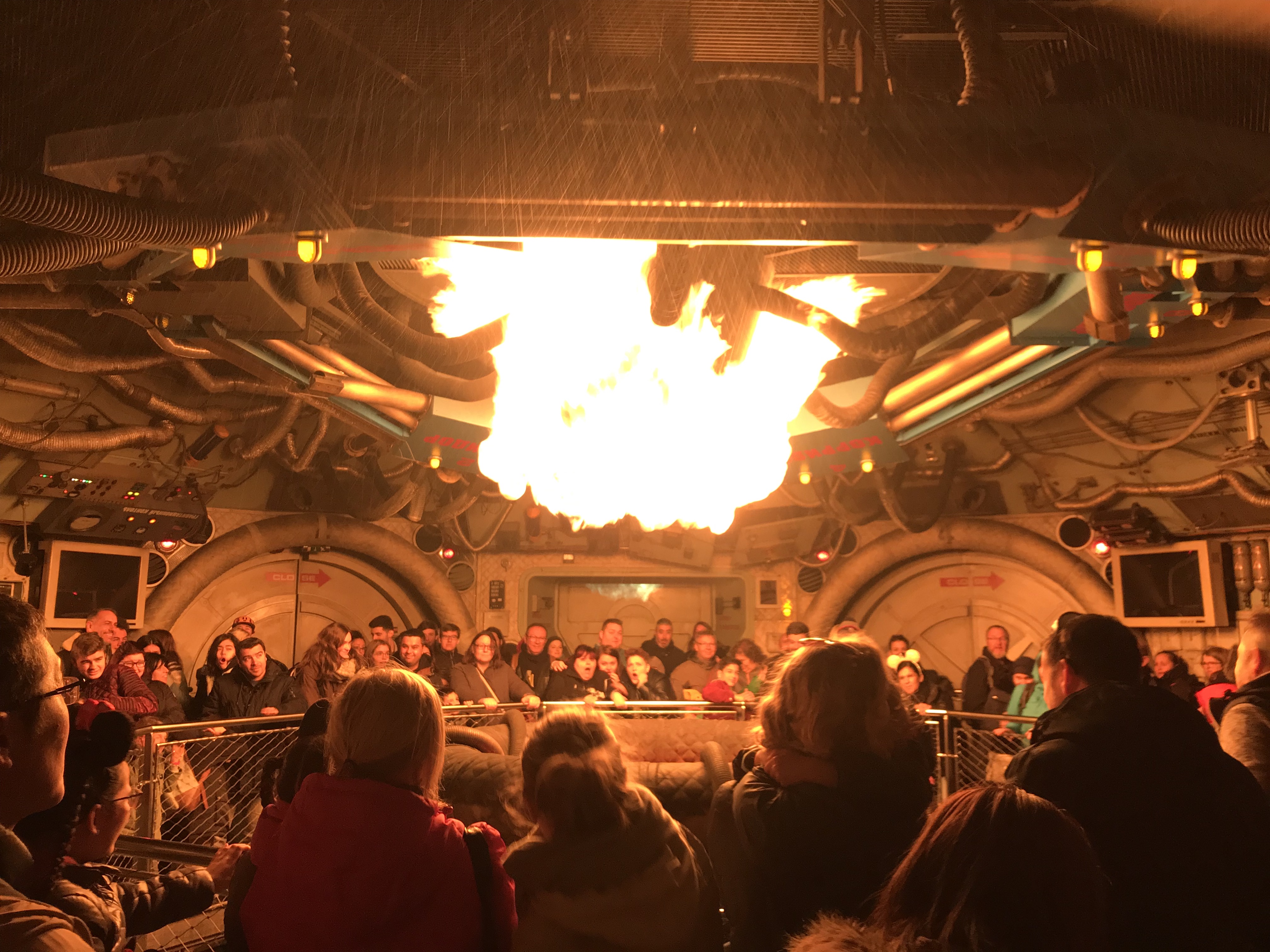
Armageddon: Les Effets Spéciaux (2002–2019) offered the chance to experience the apocalypse from the inside. Plunged into the Russian orbital station Mir from the Michael Bay film, visitors suffered a meteor shower, complete with depressurization, fires, and ceiling destruction, in one of the most intense enclosed spaces ever built by Disney.
Finally, the Rock 'n' Roller Coaster starring Aerosmith (2002–2019) propelled visitors to 100 km/h in less than three seconds, straight into the mouth of a giant electric guitar. It was the pride of the park, the big thrill for teenagers, where each train broadcast a different playlist of the Boston rock band — an exclusivity of the Parisian version, absent from its Floridian counterpart.
The Tower of Terror (2007): The Building That Changed Everything
The skyline of Marne-la-Vallée was turned upside down on December 22, 2007. A 60-meter-high structure with dilapidated facades, struck by lightning and eaten away by ivy, rose at the end of the brand new Hollywood Boulevard: The Twilight Zone Tower of Terror opened its doors and instantly became the centerpiece of the park.
The Parisian version is a unique architectural feat: it is the only Hollywood Tower Hotel in the world built of reinforced concrete rather than a metal frame, an adaptation made necessary by French construction standards of the time. Paradoxically, this concrete gives the Parisian tower a solidity and a surface texture slightly different from its American sisters, and some fans claim it accentuates the crushing mass effect of the building.
Inside, the level of detail is obsessive. Imagineers scoured the flea markets of Saint-Ouen and Californian antique shops to source more than 5,000 period props: luggage abandoned in 1939, an old edition of the Los Angeles Times, broken glasses in the library, an interrupted game of Mahjong. The names inscribed in the hotel's reception register are those of the actual Imagineers who designed the attraction.
The attraction propels and pulls its visitors down in elevator shafts gone mad, causing real feelings of weightlessness. In September 2019, it received the most beautiful update in its history, entitled A New Dimension of Chills: three different and random scenarios — The Malevolent Machine, The Shaft Creatures, The Fifth Dimension —, making each journey unpredictable.


Toon Studio, Toy Story & Ratatouille: The Age of Immersion
In 2007, to compensate for the lack of family attractions, the Animation Courtyard became Toon Studio. The pearl of this zone is called Crush's Coaster, a swirling dark ride simulating the East Australian Current from Finding Nemo, which became so popular that its queue would never empty again over the next twenty years. The attraction, unique in the world in its design — the vehicles spin randomly on themselves in the dark —, regularly accumulates more than two hours of wait time right from the moment the doors open.
In 2010, the park expanded considerably with the opening of Toy Story Playland, an immersive land where the visitor is shrunk to the size of a toy amidst gigantic blades of grass, giant footprints from Andy, and three new family attractions. Toy Soldiers Parachute Drop, Slinky Dog Zigzag Spin, and RC Racer rounded out an offering that had until then been too meager for families with young children.
But the real conceptual turning point took place on July 10, 2014, with the inauguration of La Place de Rémy. The park welcomed its first major world exclusive: Ratatouille: The Adventure. This revolutionary trackless dark ride — without a fixed rail, the vehicles moving freely in space — plunges the visitor to the height of a rodent right in the heart of Gusteau's kitchens, alternating oversized physical sets (five-ton hams, refrigerators as big as buildings) and giant projections.
This area won a Thea Award for the excellence of its theming. More than an attraction, it is one of the most beautiful corners of Paris ever built in Paris. The smell of hot bread escaping from the fake ventilation grilles, the trickling of the fountain, and Michael Giacchino's music made La Place de Rémy the favorite refuge of purists.


Mickey and the Magician (2016): The Scenic Miracle
In July 2016, succeeding Animagique in its own theater bordered on Mission: Impossible. Disney installed Mickey and the Magician there, a musical show celebrating illusionism, produced exclusively for the Parisian audience. It would be one of the greatest stage successes in the modern history of the company.
The premise is simple but brilliant: Mickey, relegated to sweeping in the great Magician's workshop, tries his hand at magic during his master's absence. Each attempt triggers the appearance of a great Disney classic — Beauty and the Beast, Aladdin, The Lion King, Frozen, Cinderella. But what stuns the audience is the technical execution: live disappearances before the spectators' eyes, spectacular levitations, clothing transformations in a fraction of a second. The show was designed in collaboration with internationally renowned professional magicians, ensuring that each trick is a true feat of illusionism.
The Aladdin scene, where the Genie materializes objects out of nowhere in an explosion of colors, or the Frozen scene, where Elsa literally makes ice crystals erupt from the stage floor, systematically generate standing ovations.
The show fills its nearly 1,000-seat theater five to six times a day. Its artistic excellence, rewarded by the IAAPA, is such that it has established itself as the absolute benchmark for live entertainment in European theme parks.

Seasons and Events: The Park That Never Slept
If there is one area where Walt Disney Studios Park largely surpassed its big brother, it is in its ability to transform itself for special events. Far from being just a daytime park, it has become over the years the true event and nightlife laboratory of the destination.
The Terrorific Nights (2009–2012) constitute the most transgressive event in Disney's history in Paris. These evenings, officially not recommended for children under 12, plunged the park into a bloody fog. Actors, chainsaw in hand, roamed the areas, monsters emerged from Catastrophe Canyon in direct terror, and a life-size psychiatric asylum — the Sanitarium — was built from scratch in the Backlot. The atmosphere, halfway between an American horror park and an immersive art installation, was unparalleled in Europe.
Electroland (2017–2019) represents the other extreme of the spectrum: a major electronic music festival right in the heart of Disney. International DJs like Steve Aoki, Alesso, or Martin Solveig mixed in front of tens of thousands of festival-goers. The stroke of genius lay in the use of the Tower of Terror as a giant video mapping canvas, its 60 meters of facade visually vibrating to the rhythm of the bass — an image that has become iconic in the community of electronic festival lovers.
Season of the Force (2015–2020) installed Star Wars in the heart of the Production Courtyard every winter. Stormtrooper patrols led by Captain Phasma enforced order in the crowd, transforming the pathways into a live movie set. At nightfall, Star Wars: A Galactic Celebration illuminated the Hollywood Tower Hotel with massive projections synchronized with jets of flames and lasers.
Magical Pride (2019–2023) had the honor of hosting the first official Pride March organized inside a Walt Disney Company park in the world. Privatized, vibrant, and festive evenings, with headline concerts and a Tower of Terror backlit in rainbow colors.
Le Rendez-Vous Gourmand and L'Hiver Gourmand (2017 to present), directly inspired by Epcot's Food and Wine Festival, transformed the pathway leading to Ratatouille into a seasonal gastronomic paradise. Charming wooden chalets offered mulled wine, crêpes, tartiflette, or abbey beer, giving the park an atmosphere of urban strolling highly appreciated by locals and Annual Passholders.

Easter Eggs and Park Secrets
A Disney park cannot be conceived without an infinity of hidden details intended for enthusiasts. Walt Disney Studios Park is full of these nods, testifying to the designers' respect for the history of the studios.
All the clocks stopped at 8:05 pm: look at every watch, every clock in the sets of the Tower of Terror. They all show exactly 8:05 pm. It was at this exact minute, on the evening of October 31, 1939, that lightning struck the Hollywood Tower Hotel, freezing time for eternity.
The WED 1901 plate: in the old Backlot, an old black truck proudly sported the license plate 512 WED 1901. WED for Walter Elias Disney, and 1901 for his birth year. A discreet tribute to the founder, slipped into the industrial setting without fanfare.
The A-113 code everywhere at Pixar: this classroom number from the prestigious CalArts is hidden on the license plate of a car in Cars Quatre Roues Rallye, and on the oversized driver's license of the RC Racer attraction.
The shrinking cobblestones: at the exit of Ratatouille, the floor tiles gradually shrink with each step, until they return to a standard human size. A detail of environmental storytelling that most visitors never consciously notice, but which works on everyone.
The ghost of the little girl: in the boiler room of the Tower of Terror, a wall features a strange chalk circle. Photographed with the flash activated in the right place, the shadow of a child's silhouette appears on the snapshot — a direct reference to little Sally Shine, the ghost child of the Parisian scenario of the attraction.
The Numbers of a History
March 16, 2002: opening to the public. The second park of the European resort is born.
From 2.2 million to 5.7 million: the spectacular evolution of attendance between the low year of 2003 and the historical record of 2023, raising the park to the rank of the third most visited park in Europe.
Two Thea Awards, the Oscar of the theme park industry: one for the CinéMagique show in 2003, the other for the exceptional theming of La Place de Rémy and Bistrot Chez Rémy in 2015.
Approximately 46,000 performances played by the cast of CinéMagique before its closure in 2017.
Over 90% of the sets and areas of the original 2002 park have been modified, demolished, or entirely reinvented over its twenty-four years of operation.

요약
Walt Disney Studios Park was never the park it was asked to be. It arrived too small, unloved, decried by purists. And then, against all odds, it held its own. It grew in spurts, mourned its lost attractions — CinéMagique, Animagique, Moteurs… Action!, Armageddon, the Studio Tram Tour — and gave birth to new ones that redefined what a European theme park could achieve. It became the nocturnal playground for a whole generation of fans with the Terrorific Nights and Electroland. It had a soul, imperfect, asymmetrical, but terribly endearing. On March 29, 2026, it changed its name to become Disney Adventure World. You don't destroy 24 years of memories. You transmute them.
참고 자료
- Chronique Disney – CinéMagique, full history
- Chronique Disney – Moteurs… Action!, history and role of Rémy Julienne
- Wikipedia FR – Walt Disney Studios Park / Disney Adventure World
- DisneylandParis News – 13 secrets about the Tower of Terror
- DisneylandParis News – New Tower of Terror queue The Patio (2026)
- DisneylandParis News – Walt Disney Studios Park celebrates its 20th anniversary
- Wikipedia EN – Walt Disney Studios Park (Disney Adventure World)
- DisneylandParis News – Adventure on a Grand Scale: transformation into Disney Adventure World